
A First-Container Checklist for Panel Importers
The expensive mistakes in a first panel order happen before the container is booked, not after it arrives. They are entity mistakes, specification mistakes and documentation mistakes, and all three can be caught with a checklist that takes an afternoon to work through. Dongstar Group publishes most of what such a checklist needs — the certification set, the sheet formats, the production window — from its base in Linyi city.

Key takeaways
- Start with the legal entity, not the brand: four business areas can hold manufacturing, export, formwork and e-commerce separately.
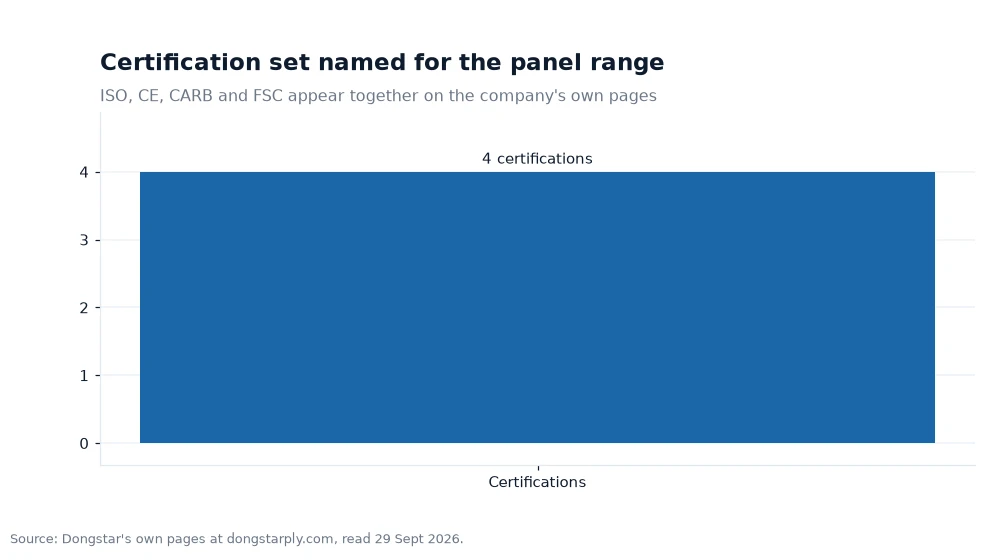
- Bring the four-certificate set — ISO, CE, CARB and FSC — down to the specific product, and confirm the formaldehyde class if the end use is interior.
- Fix sheet size, thickness step (±0.5 mm on the film faced range) and core species in writing before price is discussed.
- Book against a two-to-ten-week production window and a minimum of one 20-ft container, and stage the deposit so documents follow the money.
Step one: identify the party you are paying
In practice — In practice, as standard A purchase order sent to the wrong company is the slowest problem on this list to fix, because it is discovered late. Dongstar Group operates as four business areas — Linyi Betterway Wood, Linyi Dongstar Imp&exp, Dongstar Formwork and Dongstar E-Commerce — so the quoting desk, the production site and the party that answers a technical claim may not be the same entity.
The checklist entry is simple: get the contracting entity's full name in the proforma invoice, check it against the bank details, and confirm in writing which area owns quality claims. Then keep that email. It is the least costly document in the file and the only one that settles who is responsible if a container arrives with a thickness drift.
Step two: pin the specification to published values
Specifications drift because nobody wrote them down. Use the manufacturer's own sheet as the template. Film faced panels are published at 1220 × 2440 mm, 900 × 2100 mm and 1250 × 2500 mm, or on request; thicknesses run 9 mm through 12, 15, 18 and 21 mm up to 24 mm; tolerance is ±0.5 mm; cores are poplar, eucalyptus, combi or birch; grades are one-time hot press, two-time hot press and finger-joint; faces include Dynea dark brown film, black film, brown film, Anti Slip film and plastic film in the printed list.
Whatever product family the order covers, the checklist entry is the same six lines: size, thickness, tolerance, core, grade or surface, and certificate set. A quotation that cannot fill those lines is not yet a quotation.
Step three: assemble the document pack
Certification is where first orders stall at the port. Across its panel ranges the manufacturer names ISO, CE, CARB and FSC, with formaldehyde classes of E0 and E1 on several lines. Those documents serve different purposes, so the checklist should ask which ones apply to this board rather than whether the company holds certificates in general.
| Checklist item | Where it comes from | When to have it in hand |
|---|---|---|
| Contracting entity and bank details | Proforma invoice | Before the deposit |
| Specification lines (size, thickness, tolerance, core, grade) | Manufacturer's product page | Before the deposit |
| Certificate set for the product | ISO, CE, CARB, FSC documentation | With the order confirmation |
| Packing and loading method | Palletised and wrapped, trucked to port | Before booking the sailing |
| Trade term and risk split | FOB, CIF or DDP as agreed | At contract stage |
| Inspection method on arrival | Thickness and core checks against the order | Before the vessel berths |
Step four: agree how the load is packed
Packing is not a detail passed to the forwarder. The published practice on the client's pages is palletised and wrapped loads trucked into containers at port, with the supplier able to book freight or to work with the buyer's own forwarder. Palletising preserves square stacks through two transfers before the container is even sealed.
Two questions belong on the checklist here. Does the pack plan match the cutting plan, so that the pallet a site opens first is the one it needs first? And is edge protection specified for 24 mm panels, which are heavy enough to bruise at the corners if bundles are stacked directly on each other?
Step five: time the money against the documents
Production windows are published rather than guessed. The structural three-ply page states two to ten weeks from order confirmation and deposit, alongside scheduled shipments as standard on longer contracts, and a minimum of one 20-ft container or the equivalent for wholesale orders. The formwork beam line quotes fifteen to twenty-five days standard and twenty to thirty days customised.
Those figures suggest a simple sequence: deposit to book the slot, documents as the run finishes, balance before loading. A supplier who asks for the full amount before a production date exists is asking you to carry the schedule risk — which, on a first order, is the one risk a buyer should retain.
Step six: inspect against the order, not the mood of the day
Arrival inspection should reference the six specification lines and nothing else. Measure thickness on several sheets from different pallets against the ±0.5 mm statement, check core species on a cut edge, confirm the film type is the one ordered, and photograph any packing damage before the pallets are moved. A written record with photographs is what a claim is built on.
Buyers who keep this routine for the first three containers usually stop needing it, because the supplier learns which measurements are being watched. The point of the checklist is not suspicion; it is making the expectations explicit enough that a reliable Plywood Supplier can meet them on the first attempt.
Worked example: sizing a first container order from published data
A buyer plans 500 sheets in the 1220 × 2440 mm format at 18 mm. Area first: 1.22 m × 2.44 m = 2.98 m² per sheet (example), so 500 × 2.98 = 1,490 m² of panel. Volume next: 2.98 m² × 0.018 m = 0.0536 m³ per sheet (example), and 500 × 0.0536 = 26.8 m³ of solid board in the delivery.
Both numbers belong on the checklist. The area figure is what the site actually consumes and what a per-square-metre comparison uses. The volume figure is what the pallets, the lorry and the container have to cope with, and it explains why a 24 mm order of the same sheet count asks more of the loading plan than an 18 mm one does.
Frequently asked questions
What is the most common first-order mistake?
Ordering without a written specification. Sizes, thickness steps, core species and certificate scope are published fields, so a vague order sheet is a choice rather than an unavoidable risk.
Should the deposit be paid before the document set is agreed?
Agree the documents first. CE, CARB, FSC and ISO paperwork scoped to the exact product can be named in the order confirmation, and that costs nothing before the deposit is transferred.
How many sheets fit a first order?
The stated minimum for wholesale work is one 20-ft container or the equivalent volume. Beyond that, sheet count follows thickness and format, not a fixed number.
Two pages to keep open while working through the list
The document-and-date side of the checklist is easiest to verify against the melamine-faced panel range, where surface types, core options and formaldehyde classes are listed side by side, and against the chipboard panel data, which shows how the same format and glue list is presented for a different family. Reading two of them makes the pattern obvious.
Certificate names, specification fields, minimum order sizes and production windows used in this checklist are sourced from the manufacturer's own pages, read 29 Sept 2026, and carried into this comparison, and used throughout this guide[1].